
 English
 русский
 Français
 Español
 中文简体
中文简体

Jacquard Oxford Fabric: Durability Meets Design
2026-04-30
Content
- 1 Defining the Jacquard Weave on Oxford Base
- 2 Material Composition and Technical Specifications
- 3 Why Woven Patterns Outperform Prints
- 4 Water Resistance and Coating Technologies
- 5 Manufacturing Scope and Industrial Applications
- 6 Care, Maintenance, and Longevity Practices
- 7 Supply Chain and Quality Markers
Jacquard Oxford fabric is the direct answer when you need a textile that combines high tensile strength with intricate, fade-resistant patterns. Unlike printed fabrics where designs sit on the surface, the pattern here is woven directly into the structure, ensuring the visual detail lasts as long as the abrasive resistance of the base cloth.
Defining the Jacquard Weave on Oxford Base
To understand the material, you must separate the weave mechanism from the yarn structure. The jacquard process uses a loom attachment to control individual warp threads, allowing for complex curvilinear and geometric motifs. When applied to an Oxford base—typically a modified plain weave using coarse count yarns—the result is a fabric that feels substantial yet precise. The standard Oxford structure uses a dual-yarn warp crossing a heavier fill, creating a basketweave texture that gives the fabric body. When jacquard patterning is added, the surface gains dimensional depth without compromising the fabric's innate stiffness.
Material Composition and Technical Specifications
The performance metrics depend heavily on fiber content. Most high-utility Jacquard Oxford is polyester-based or nylon-based, sometimes blended with cotton for a softer hand feel.
| Property | Polyester Jacquard Oxford | Nylon Jacquard Oxford | Cotton-Poly Blend |
|---|---|---|---|
| Denier Range | 150D - 1680D | 210D - 840D | 300D - 600D |
| Abrasion Resistance | High (>50,000 Martindale cycles) | Excellent (>100,000 cycles) | Moderate |
| Water Resistance | PVC/PU coating dependent | Often silicone/PU coated | Low (requires treatment) |
| Pattern Fidelity | Sharp, holds structure well | Slightly softer drape | Matte, vintage aesthetic |
The tensile strength of 600D Polyester Jacquard Oxford can reach upwards of 150 lbs in warp and fill, making it a standard choice for luggage that undergoes baggage handling stress.
Why Woven Patterns Outperform Prints
In printed textiles, the design is a surface treatment bonded via adhesive or heat. Under mechanical stress or UV exposure, these prints can delaminate or peel. Jacquard methodology integrates the color directly into the yarn stage. Solution-dyed polyester yarns are pigmented before extrusion, meaning the color identity permeates the entire fiber cross-section. The woven pattern then becomes a structural element. This results in a fabric where abrasive rubbing does not degrade the design because the design is not a separate layer; it is the fabric itself.
Water Resistance and Coating Technologies
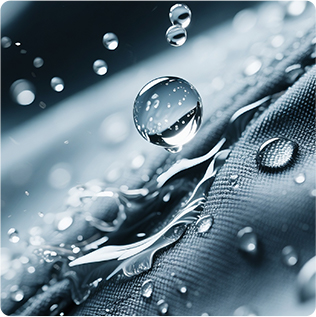
Raw Oxford polyester is not inherently waterproof, but its tight basketweave offers a degree of water repellency at high densities. Functional Jacquard Oxford fabrics almost always feature a backing lamination. A standard technical specification is a PU (polyurethane) coating ranging from 200mm to 800mm on the hydrostatic head test. Some variants use PVC coatings, which increase the waterproof rating to over 1000mm but add significant weight. For damp climates, a fabric with a 600D face weave and a 2x PU backing provides a balance where water beads and rolls off without saturating the fiber, keeping the dry weight of a backpack low.
Manufacturing Scope and Industrial Applications
The industrial utility of this material spans sectors that demand zero structural failure. In luggage manufacturing, the fabric is cut using automated CNC knife systems that require the fabric to have a specific stiffness to prevent edge fraying. In upholstery, double rub counts exceeding 50,000 are a prerequisite for commercial contract use. The material also finds use in automotive interiors and high-end packaging sleeves where tactile impression matters.
Luggage and Tactical Backpacks
The 600D and 1680D ballistics-inspired Jacquard Oxfords dominate this category. The woven camo or geo patterns serve not just visual branding but also help hide scuffs inevitable on conveyor belts. Tactical applications often specify an IR (infrared) reflective treatment integrated into the backing.
Footwear and Structured Panels
Shoe manufacturers utilize Jacquard Oxford for toe guards and heel counters. The pattern precision allows for branded monogram effects without embroidery, reducing the number of needle perforations that can weaken the panel's structure.
Care, Maintenance, and Longevity Practices
Cleaning requires a method that does not breach the lamination backing. Saturation in hot water or machine washing with agitators can crack the PU backing, creating a delamination bubble. Best practice involves cold water spot cleaning with a soft brush. For sanitization, diluted alcohol sprays evaporate quickly enough to avoid soaking the backing. When dried flat, a quality Jacquard Oxford should retain its dye integrity, with a colorfastness to light rating of grade 4 or higher (ISO 105 B02), ensuring minimal yellowing or fading even after 200 hours of Xenon arc exposure.
Supply Chain and Quality Markers
When sourcing, independent of brand identity, you must cross-check the physical specification sheet against the sample. Key markers of quality include the number of picks per inch and the denier consistency. A fabric labeled 600D should have a yarn weight near the 600 denier mark, not diluted with 300D fill to save cost. Weight tolerance should be within plus or minus 5%. The jacquard selvedge should be clean, without broken warp floats that indicate loom timing issues. The hand feel should be crisp but not papery; excessive paperiness often signals overuse of stiffening fillers that wash out after the first wet cycle.



地址:
中国浙江省杭州市萧山区南阳街道岩峰村
Add:
Yanfeng Village, Nanyang Street, Xiaoshan District, Hangzhou,Zhejiang Province, China.


Copyright © Hangzhou Xiaoshan Wenfa Textile Co., Ltd.
All Rights Reserved.
 Polyester Fabric Manufacturers
Oxford Fabric Manufacturers
Polyester Fabric Manufacturers
Oxford Fabric Manufacturers