How Denier Shapes Strength, Weight, and End‑Use
Denier (D) measures the linear mass density of yarn – a higher number means thicker, heavier threads. With recycled polyester, the same rule applies, but the sustainability story transforms material selection into a strategic decision. At Hangzhou Xiaoshan Wenfa Textile Co., Ltd., we help buyers align denier choice with real‑world performance, avoiding costly over‑engineering.
| Fabric Specification |
Typical Weight (gsm) |
Characteristic |
Common Applications |
| 200D Recycled Polyester Fabric |
~110 – 130 |
Lightweight, supple drape |
Lining, light daypacks, packing cubes, children’s items |
| 300D Recycled Polyester Fabric |
~145 – 165 |
Balanced hand, good tear resistance |
School bags, tote bags, promotional backpacks |
| 500D Recycled Polyester Fabric |
~210 – 240 |
Semi‑rigid structure, high abrasion resistance |
Luggage shells, tool bags, outdoor gear |
| 1200D Recycled Polyester Fabric |
~350 – 400 |
Heavy-duty, extremely durable, rigid |
Industrial covers, heavy luggage, pet products |
Denier selection determines the strength‑to‑weight profile of Recycled Polyester Fabric. Use this as a guide, not a substitute for specific testing.
Note that fabric construction (weave density, coating, lamination) can further modify the final performance. Even a 300D Recycled Polyester Fabric with a tight Oxford weave and a durable water repellent finish can rival heavier uncoated materials for some applications. We always recommend requesting a lab dip or sample yardage to validate hand‑feel and strength.
Reading Certifications: How to Authenticate Recycled Content
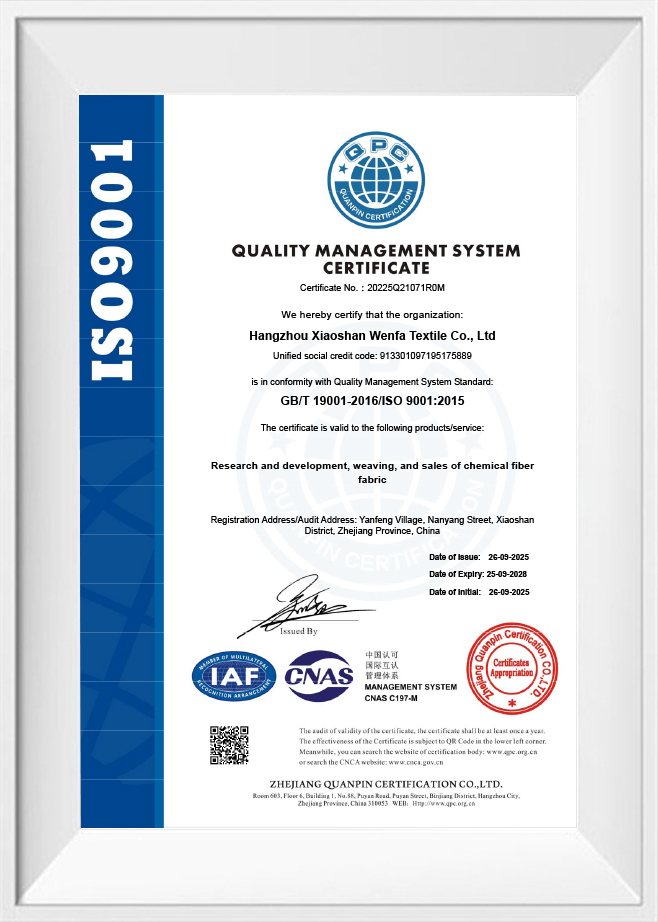
The market for Recycled Polyester Fabric demands more than a green label. Third‑party certifications create a transparent chain of custody from bottle to bolt. At Hangzhou Xiaoshan Wenfa Textile Co., Ltd., our certifications are audited annually, giving buyers documented confidence.
Key Standards You Should Look For
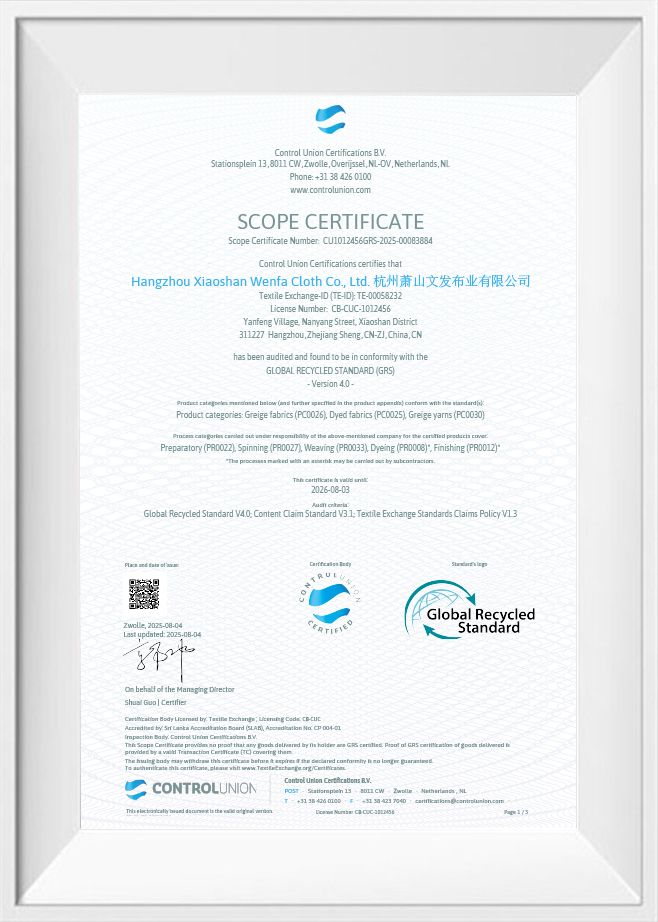
- GRS (Global Recycled Standard) – Verifies the percentage of recycled content and tracks it through the entire production process. It also imposes social and environmental criteria on processors.
- OBP (Ocean Bound Plastic) – Certifies that the raw material was collected from areas at risk of polluting the ocean, adding a layer of direct environmental intervention.
- REACH (Registration, Evaluation, Authorisation of Chemicals) – Guarantees that the finished fabric contains no substances of very high concern, crucial for products that touch skin or are used by children.
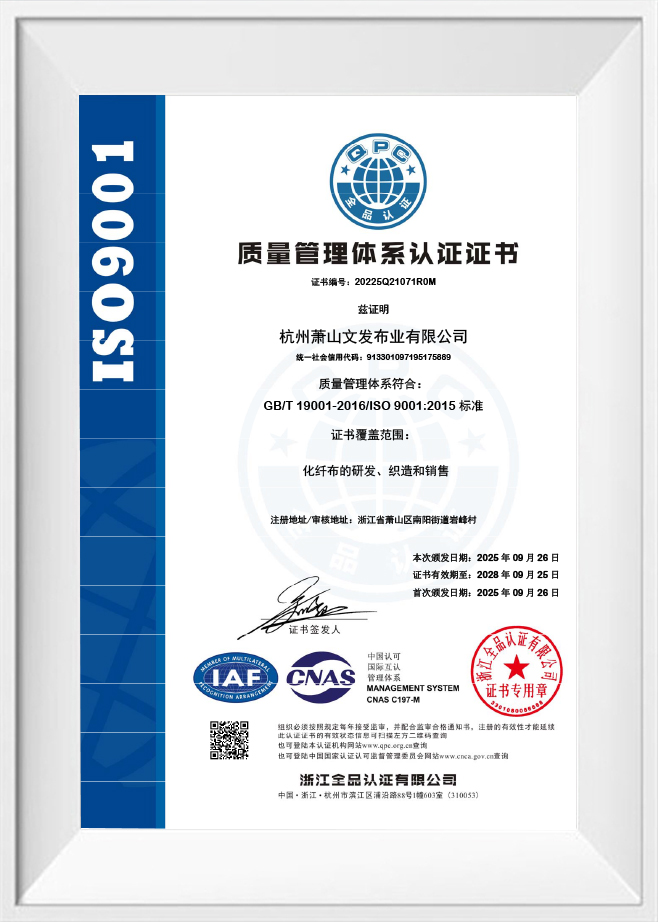
- ISO 9001 – While not specific to recycled content, it confirms that the manufacturer operates under consistent quality management, reducing batch‑to‑batch variability.
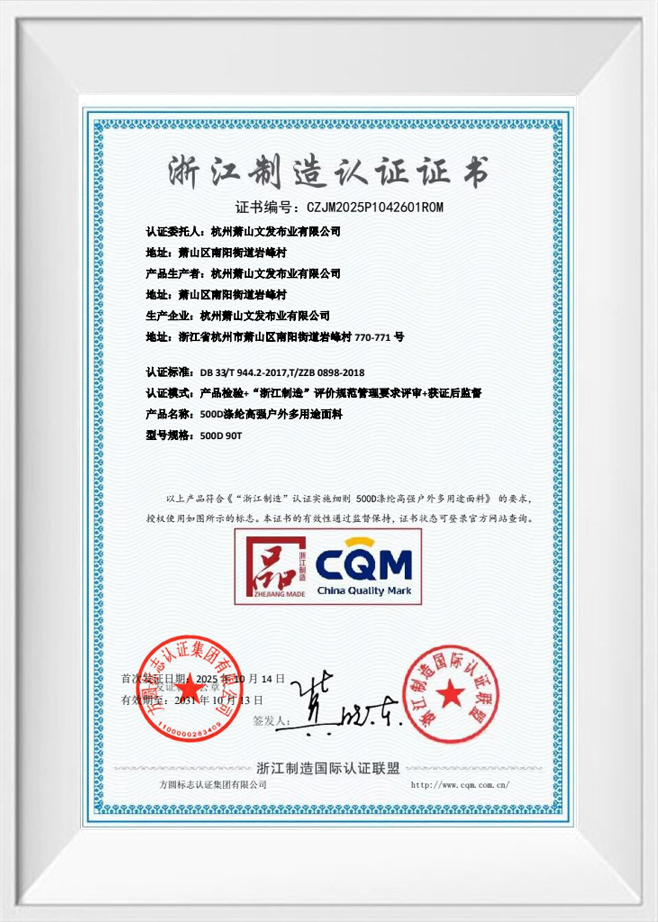
A common pitfall is assuming that a single certificate covers all fabric types. Always request the scope certificate for the exact denier and composition you intend to buy. For example, our GRS scope explicitly covers 200D Recycled Polyester Fabric, 300D Recycled Polyester Fabric, 500D Recycled Polyester Fabric, and 1200D Recycled Polyester Fabric, ensuring there is no ambiguity.
Dyeing Behavior and Long‑Term Color Retention
Recycled polyester fibers originate from post‑consumer bottles, and the melt‑spinning process gives them a slightly different molecular orientation compared to virgin chip. In practice, this means Recycled Polyester Fabric can achieve equal or even superior color depth due to a more open amorphous region that accepts disperse dyes readily. However, managing batch consistency requires precise control.
How We Minimize Shade Variation
- Source bales of clear, light‑blue‑tinted PET bottles to start with a uniform feedstock, avoiding yellowing from colored bottles.
- Blend recycled chips in mega‑batches before extrusion, which averages out subtle viscosity differences.
- Use computer‑controlled dyeing machines that track temperature ramp and pH with a tolerance of ±0.1, essential for deep shades on 500D Recycled Polyester Fabric or heavy 1200D Recycled Polyester Fabric.
- Apply post‑dye fixing agents specifically formulated for recycled PET to boost wet‑fastness by up to 0.5 grade on the grey scale.
From a care perspective, washing in cold water and avoiding bleach will keep the color intact for the product’s lifespan. Hangzhou Xiaoshan Wenfa Textile Co., Ltd. provides comprehensive care labels with every shipment, based on AATCC accelerated aging tests conducted on each production run.
The Carbon Footprint Equation: Recycled vs. Virgin Polyester
Life cycle assessment (LCA) data shows that Recycled Polyester Fabric offers a tangible environmental advantage over petroleum‑derived virgin polyester. The savings come primarily from skipping the extraction and refining of crude oil, which are energy‑intensive steps.
| Impact Indicator |
Virgin Polyester (per kg) |
Recycled Polyester Fabric (per kg) |
Reduction |
| Energy consumption |
~95 MJ |
~35 – 45 MJ |
~50 – 60% |
| CO₂ emissions |
~4.0 kg CO₂eq |
~1.5 – 2.5 kg CO₂eq |
30 – 50% |
| Water usage |
~60 L |
~15 – 25 L |
~60 – 75% |
Based on cradle‑to‑gate LCA studies for mechanically recycled PET. Actual values vary by logistics and energy mix. Data sources: European Textile Exchange, peer‑reviewed industry reports.
These numbers mean that every roll of our Oxford fabric – whether light 200D Recycled Polyester Fabric or heavy 1200D Recycled Polyester Fabric – carries a substantially smaller environmental backpack. Hangzhou Xiaoshan Wenfa Textile Co., Ltd. is committed to maintaining this advantage by optimizing transport and minimizing process waste, turning post‑consumer bottles into high‑performance textiles with measurable impact.

 English
 русский
 Français
 Español
 中文简体
中文简体