
 English
 русский
 Français
 Español
 中文简体
中文简体
Why Most Abrasion Specs Fail Before Production Even Starts Most rejected fabric orders are not caused by weak material — they are caused by vague specification...
READ MORE
Eco-Friendly Polyester Fabric Suppliers
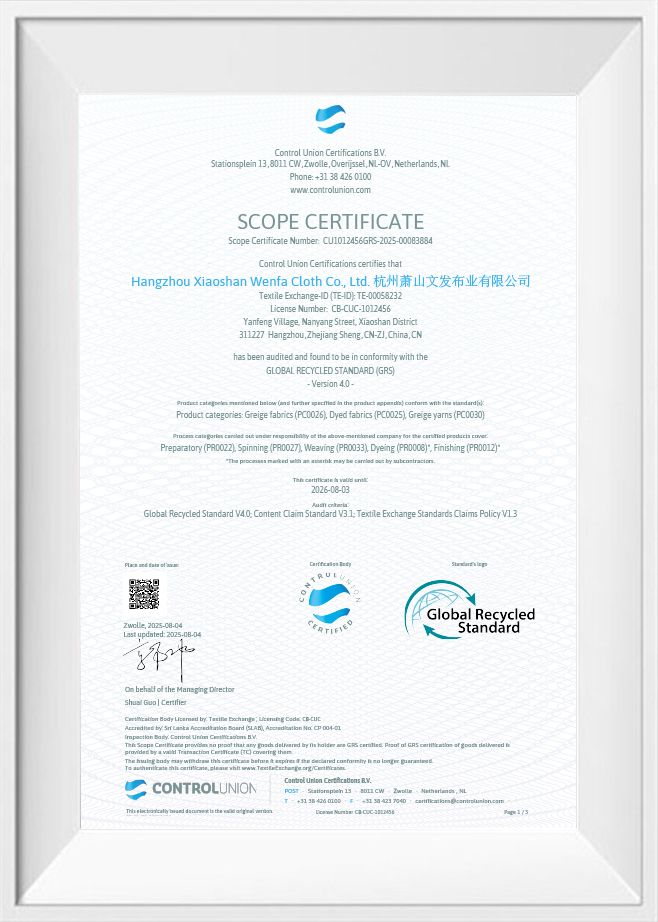
We are dedicated to sustainable development in harmony with nature, holding GRS, OBP, and OCI certifications, with extensive use of eco-friendly materials in manufacturing.
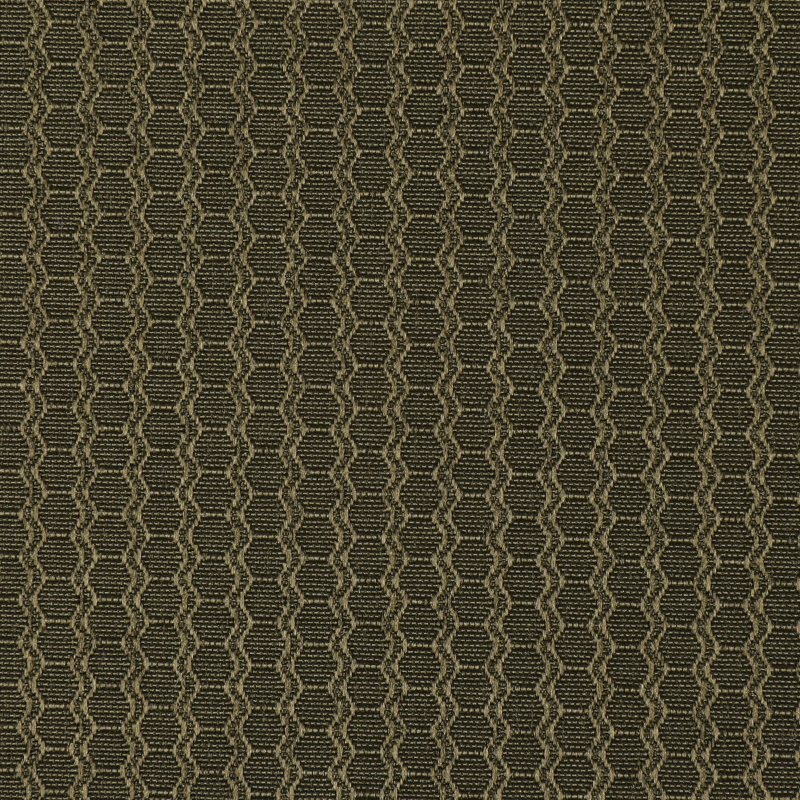
ECO-FRIENDLY POLYESTER FABRIC is developed under the concept of "sustainable development in harmony with nature". It breaks through the environmental drawbacks of traditional polyester, realizing the integration of functional performance and ecological responsibility in textile production.
The fabric has obtained three authoritative certifications, ensuring its eco-friendly attributes from multiple dimensions: GRS (Global Recycled Standard) certifies its recycled material application; OBP (Ocean Bound Plastic) certification confirms its contribution to reducing marine plastic pollution; OCI certification guarantees compliance with strict ecological production standards.
Extensive use of eco-friendly materials is the key feature of ECO-FRIENDLY POLYESTER FABRIC. It replaces virgin petroleum-based raw materials with recycled or renewable resources, reducing carbon emissions and resource consumption during the manufacturing process, and laying a solid foundation for the sustainable development of the textile industry.
View More
Message Feedback
About Us
Hangzhou Xiaoshan Wenfa Textile Co., Ltd. specializes in the production and sales of Oxford fabric, Eco-Friendly Polyester Fabric Suppliers and Eco-Friendly Polyester Fabric Company, integrating R&D, manufacturing, and sales. With around 300 employees and nearly 300 sets of machinery, including 200 water-jet looms, the company maintains a daily output of approximately 160,000 meters of fabric, ensuring stable supply and reliable quality.
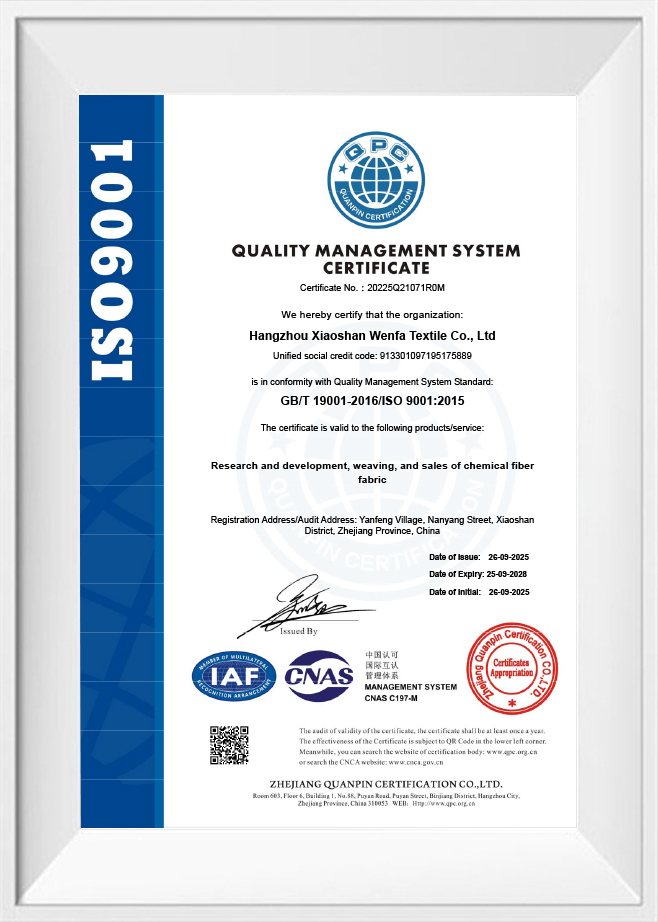
The company holds ISO certification as well as REACH, GRS, and OBP standards, reflecting its commitment to quality and sustainability. Supply Eco-Friendly Polyester Fabric Wholesale. Its Oxford fabric is widely used in luggage, outdoor gear, and children's products, serving both domestic and international markets including Europe, the Americas, and Southeast Asia. Moving forward, the company will continue to leverage its integrated supply chain and technical expertise to be a trusted global supplier of Oxford fabric.
Welcome to Hangzhou Xiaoshan Wenfa Textile Co., Ltd.
Honor
News
-
-
The Signal Problem No Metal Box Can Solve Faraday cages have protected sensitive electronics for nearly two centuries. The problem is that modern information s...
READ MORE -
Why the Coating Matters More Than the Base Fabric A backpack that soaks through after one rainstorm and one that survives five years of daily commuting can com...
READ MORE -
Why Traditional Polyester Is Under Pressure The textile industry generates roughly 10% of global carbon dioxide emissions — more than all international flights...
READ MORE
Industry Knowledge
From Waste to Weave: The Journey of Recycled Polyester
Recycled polyester begins its life far from the loom—often in post-consumer PET bottles or discarded industrial fibers. The mechanical recycling process starts with collection, sorting, and thorough washing to remove contaminants. Cleaned flakes are then melted and extruded into chips, which are re-spun into filament yarn. Compared to virgin polyester production, this route can reduce energy use by up to 50% and lower water consumption by nearly 20%.
At Hangzhou Xiaoshan Wenfa Textile Co., Ltd., we transform these recycled inputs into high-tenacity Eco-Friendly Polyester Fabric with the same spinning and weaving precision applied to virgin fibers. Quality parity is achieved through controlled polymerization and advanced draw-twisting, which align molecular orientation to match standard industrial yarn strengths.
Key Environmental Savings per Ton of Recycled Polyester
- Avoidance of approximately 6.5 barrels of crude oil compared to virgin PET production
- Reduction of CO₂ emissions by around 3.2 metric tons
- Diversion of over 25,000 PET bottles from landfill or incineration
Decoding Ocean Bound Plastic (OBP) Certification
Ocean Bound Plastic refers to plastic waste collected from areas where it is at high risk of entering the ocean—typically within 50 km of a coastline. OBP certification, developed by Zero Plastic Oceans, verifies that the material is sourced, collected, and managed in a way that genuinely prevents marine pollution. The standard distinguishes between several collection categories, ensuring traceability from the moment the waste is picked up.
| Category | Collection Zone | Certifiable for Recycling |
|---|---|---|
| Potential OBP | Inland areas within 50 km of shore | Yes |
| Waterway OBP | Rivers, streams, and canals | Yes |
| Shoreline OBP | Beaches and coastal strips | Yes |
Our OBP-certified materials directly support these collection networks, helping to intercept plastic before it reaches the ocean. The certification also mandates ethical handling practices and a clear chain of custody, so every meter of fabric carries a verifiable environmental story.
Performance Parity: Why Recycled Polyester Doesn’t Compromise on Quality
A common misconception is that recycled polyester sacrifices strength or durability. In reality, mechanically recycled polyester fiber retains the polymer’s intrinsic tensile properties when processed with tight quality controls. Modern recycling lines can produce filaments with tenacity ranging from 4.5 to 7.0 cN/dtex, fully comparable to virgin grades used in luggage, outdoor gear, and children’s products.
Wenfa Textile’s 200 water-jet looms weave this recycled yarn into consistent fabric at a daily output of 160,000 meters, without sacrificing dimensional stability. The result is an Oxford fabric that meets the same tear strength, abrasion resistance, and colorfastness standards as conventional polyester, while being lighter on the planet.
Critical Quality Parameters for End-Use Performance
- Tensile strength retention: Properly recycled fiber typically retains over 90% of original tenacity.
- Hydrolysis resistance: Advanced drying and solid-state polymerization prevent moisture-related degradation.
- Dye uptake uniformity: Consistent chip viscosity ensures level dyeing, avoiding barré effects.
Navigating Eco-Labels: GRS, OCI, and How They Differ
Eco-labels can be confusing, yet they serve distinct purposes. The Global Recycled Standard (GRS) focuses on recycled content, chain of custody, social responsibility, and restricted chemical use. OCI certification, on the other hand, often refers to compliance with stringent ecological production standards—covering water treatment, energy efficiency, and safe chemical management during manufacturing. While GRS certifies the raw material’s recycled origin, OCI ensures the production site meets high environmental stewardship criteria.
For buyers, holding both certifications means that the fabric not only contains verified recycled inputs but is also manufactured in a facility that limits hazardous effluents and manages resources responsibly. This dual-layer guarantee is especially relevant for brands aligning with EU REACH regulations and other international compliance frameworks. We hold these certifications to give you confidence in every shipment of Eco-Friendly Polyester Fabric, ensuring integrity from fiber to finished roll.

杭州萧山文发布业有限公司
地址:
中国浙江省杭州市萧山区南阳街道岩峰村
Hangzhou Xiaoshan Wenfa Textile Co., Ltd.
Add:
Yanfeng Village, Nanyang Street, Xiaoshan District, Hangzhou,Zhejiang Province, China.
Contact us
York
Cassie
Strategic Partners


Copyright © Hangzhou Xiaoshan Wenfa Textile Co., Ltd.
All Rights Reserved.
 Wholesale Eco-Friendly Polyester Fabric Company