How Pre-Certification Eliminates Greenwashing in GRS Certificate Fabric
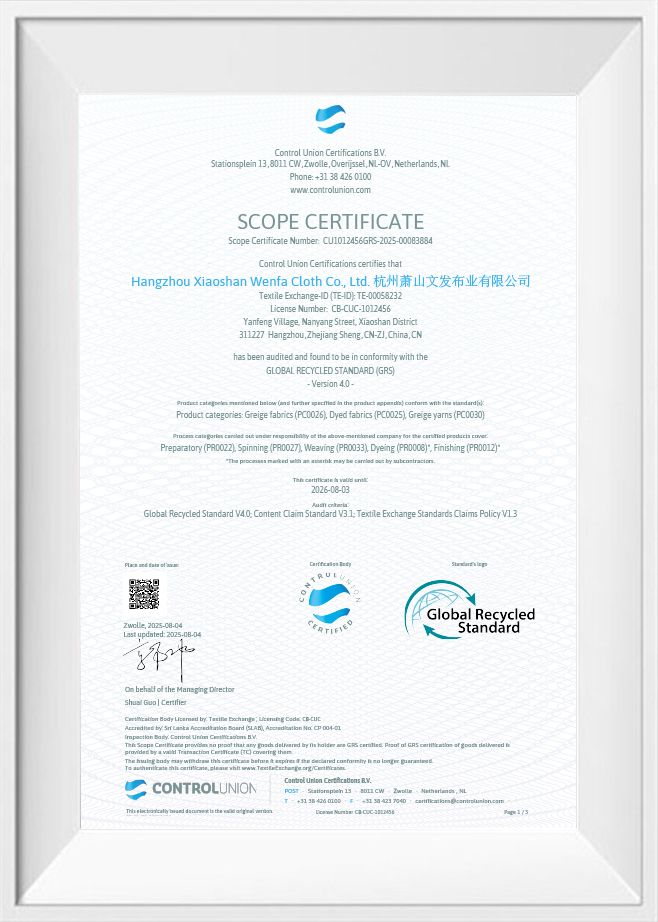
Many fabrics marketed as “recycled” lack credible evidence. The Global Recycled Standard addresses this by requiring that every raw material input—such as recycled polyester chips—originates from a supplier holding a valid GRS scope certificate. Pre-certification means the raw material has been audited before it ever reaches the fabric mill, locking in verified recycled content at the source.
This upstream verification closes the most common loophole: uncertified waste being passed off as recycled feedstock. For a fabric to be called GRS Certificate Fabric, the chain must start with a certified input, not merely a downstream claim. The result is a scientifically auditable percentage of recycled content, eliminating vague marketing terms.
- Raw material supplier holds a valid GRS scope certificate for the specific recycled material.
- A Transaction Certificate (TC) is issued by the supplier, declaring the exact input weight and recycled percentage.
- The fabric manufacturer verifies the TC against the physical shipment before accepting the material.
Without pre-certification, any recycled claim is unverifiable. At Hangzhou Xiaoshan Wenfa Textile Co., Ltd., we never compromise on this step—every raw material we procure for our GRS Certificate Fabric is pre-certified, giving buyers documentary proof of authentic recycled content right from the origin.
Traceability in Global Recycled Standard Fabric is not a single audit but a chain of Transaction Certificates (TCs) that follow the material through each change of ownership. Every link—recycler, fiber maker, spinner, weaver—must issue a TC to the next, creating a continuous, auditable paper trail. This system is what makes GRS unique among recycled content standards.
Typical Transaction Certificate Flow for Global Recycled Standard Fabric
| Stage |
Responsible Party |
TC Issued? |
Key Document |
| Waste collection & sorting |
Recycler |
No (input origin) |
Scope Certificate |
| Processing into fiber |
Fiber producer |
Yes |
TC for recycled fiber |
| Spinning |
Yarn manufacturer |
Yes |
TC for recycled yarn |
| Weaving & finishing |
Fabric mill (e.g., Wenfa) |
Yes |
TC for Global Recycled Standard Fabric |
| Product manufacturing |
Brand/garment factory |
Yes |
TC for finished product |
Each TC is a legally auditable document that must balance inputs and outputs within a 12-month period. Missing a single TC breaks the chain of custody and the final product cannot carry the GRS label. As a Global Recycled Standard Fabric Factory, Wenfa Textile meticulously manages TC documentation so that every meter of our fabric is backed by a complete, transparent custody record—making your compliance audits straightforward.
Performance Benchmarks of GRS Certificate Polyester Fabric in Outdoor & Children’s Products
A persistent concern among buyers is whether recycled polyester matches the durability of virgin material. Modern GRS Certificate Polyester Fabric, when manufactured with tight process control, performs equivalently in tensile, tear, and abrasion resistance—critical for luggage, backpacks, and outdoor gear. The key is consistent filament quality and proper weaving density, not the recycled origin itself.
Representative Mechanical Properties (600D Oxford, Recycled Content ≥50%)
- Warp tensile strength > 900 N
- Weft tensile strength > 700 N
- Tear strength (single tongue) > 120 N
- Colorfastness to light > Grade 4 (ISO 105-B02)
- Colorfastness to rubbing > Grade 4-5
For children’s products, chemical safety is non-negotiable. Beyond GRS’s own chemical requirements, our GRS Certificate Polyester Fabric is routinely tested under REACH regulation, ensuring no substances of very high concern (SVHC) exceed the 0.1% threshold. This dual-layered safety check makes the fabric suitable for strollers, carriers, and toy storage.
Our custom GRS Certificate Polyester Fabric, woven on 200 water-jet looms with integrated quality monitoring, consistently delivers these performance values. We supply brands worldwide who rely on this data to engineer durable, compliant products with full recycled content transparency.
The Synergy Between GRS, OBP, and REACH: Building a Complete Compliance Profile
A single certification rarely covers all buyer requirements. The Global Recycled Standard (GRS) verifies recycled content, traceability, and responsible processing. The Ocean Bound Plastic (OBP) certification focuses specifically on plastic waste collected from at-risk coastal areas, preventing ocean leakage. REACH, the EU chemicals regulation, controls substance safety in finished goods. Together, they form a powerful compliance triangle for sustainable textiles.
Scope comparison for common textile eco-certifications
| Certification |
Primary Focus |
Traceability |
Chemical Restrictions |
| GRS |
Recycled content & social/environmental processing |
Full chain via TCs |
Process chemicals covered |
| OBP |
Ocean-bound plastic collection & valorization |
From collection to product |
Limited |
| REACH |
Chemical substance safety in EU market |
Not a traceability standard |
Comprehensive SVHC & restriction list |
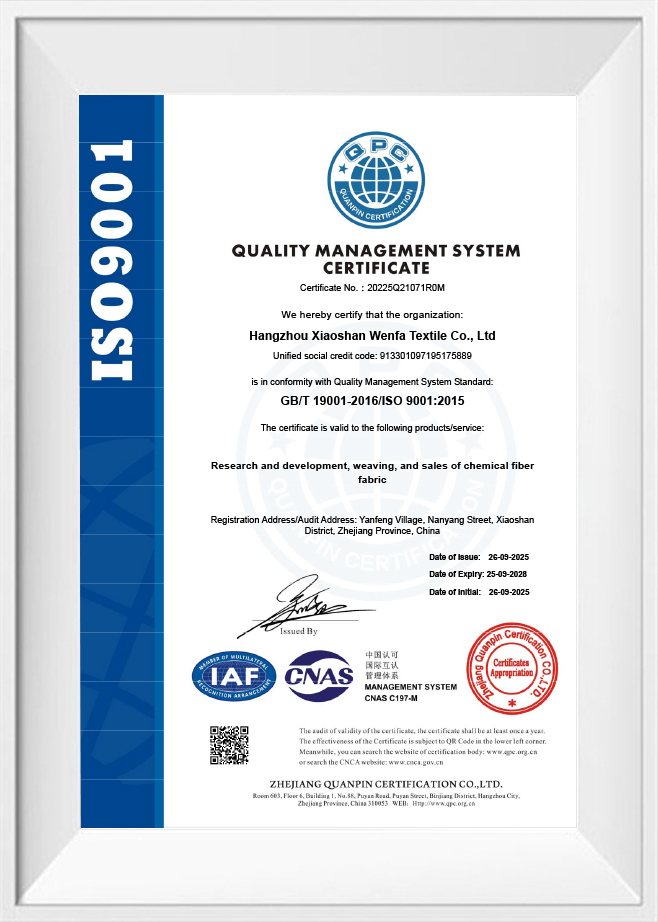
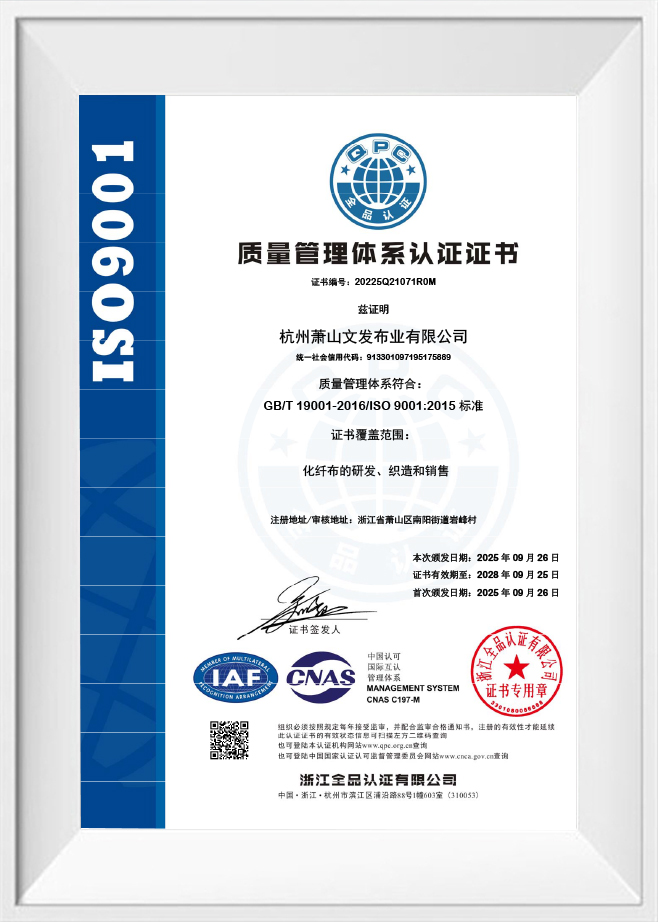
Relying solely on GRS leaves chemical substance documentation outside the EU market incomplete; combining GRS with REACH fills that gap. OBP further strengthens the environmental story by verifying that the raw material was recovered before reaching the ocean. At Hangzhou Xiaoshan Wenfa Textile Co., Ltd., we hold ISO, GRS, OBP, and REACH certifications, offering a consolidated compliance package. This reduces your auditing complexity and ensures our Oxford fabric meets the multi-layered demands of European, American, and Southeast Asian markets in one supply chain.

 English
 русский
 Français
 Español
 中文简体
中文简体