Understanding UPF Ratings and Real-World UV Blocking Performance
When sourcing Anti-Uv Fabric, it is essential to interpret UPF (Ultraviolet Protection Factor) values not as static lab figures but as indicators that can shift under actual use. A fabric labeled UPF 50+ blocks over 98% of UV radiation in a controlled, dry, and unstretched state. However, performance can drop significantly if the material becomes damp, abraded, or is tensioned over a frame—common conditions for awnings, outdoor furniture covers, and sportswear. The porosity of the weave, fiber type, and the presence of UV stabilizers determine how much protection is retained outside the laboratory.
Typical UV blockage and protection classification according to UPF rating
| UPF Rating |
UV Blockage (approx.) |
Protection Category |
| 15–24 |
93.3% – 95.9% |
Good |
| 25–39 |
96.0% – 97.4% |
Very Good |
| 40–50+ |
97.5% – >98% |
Excellent |
At Hangzhou Xiaoshan Wenfa Textile Co., Ltd., we engineer our Anti-Uv Fabric to deliver lab-verified performance that holds up under real-world tension and moisture. We recommend buyers to request test reports performed according to extended conditioning protocols, such as wet-state or stretched-state UPF measurement, to ensure the material truly matches the demands of prolonged outdoor exposure.
The Technology Behind Durable Anti-Uv Polyester Fabric
Not all polyester fabrics achieve the same UV resistance longevity. The method used to impart UV protection is the decisive factor. There are two dominant approaches: topical finishing and dope-dyeing. A topical UV finish is applied to the fabric surface and can provide excellent initial blockage, yet it gradually wears away with abrasion, washing, and weather exposure. In contrast, when UV stabilizers are integrated into the polymer melt during fiber spinning—known as dope-dyed or solution-dyed technology—the protective function becomes an inherent part of the fiber. This results in an Anti-Uv Polyester Fabric that retains its shielding capability far longer, even after repeated flexing and cleaning.
Key durability differences between methods
- Topical finishes often degrade by 30–50% in UPF retention after simulated 2-year weathering cycles.
- Dope-dyed UV polyester maintains over 90% of its original UPF under identical aging tests.
- Fiber-level protection eliminates re-treatment costs and ensures consistent performance across high-friction zones.
As one of the dedicated Anti-Uv Polyester Fabric manufacturers, our team at Hangzhou Xiaoshan Wenfa Textile Co., Ltd. prioritizes dope-dyed production lines that lock UV blockers into the polyester matrix. This provides brands with a material solution where the shield is permanent, reducing warranty claims caused by fading and tensile strength loss.
Critical Testing Standards for Long-Lasting Outdoor Fabrics
Verifying the effectiveness of an Anti-Uv Fabric goes beyond a single UPF number. Buyers should understand the suite of laboratory tests that predict how color and strength hold up after years of solar exposure. Two essential standards dominate the industry: AATCC 183 for UV transmittance and UPF classification, and ISO 105-B02 or AATCC 16 for colorfastness to artificial light (xenon arc). While the former quantifies the fabric’s shielding capacity, the latter measures whether the dye system can resist photodegradation—a leading cause of visible fading.
Key international testing methods relevant to UV-protective textiles
| Standard |
Main Focus |
Relevance to Buyers |
| AATCC 183 |
UPF rating, UVA/UVB blocking |
Quantifies protective performance |
| ISO 105-B02 |
Colorfastness to artificial light |
Predicts fading over time |
| ASTM G154 |
Accelerated weathering (UV cycles) |
Simulates material degradation |
We subject every batch from our OEM/ODM Anti-Uv Fabric factory to a combination of spectral transmittance and xenon arc testing. This dual approach ensures that both the UV barrier and the color integrity remain dependable, even under the synergistic stress of heat, moisture, and intense sunlight.
Navigating Sustainability Certifications for UV-Protective Textiles
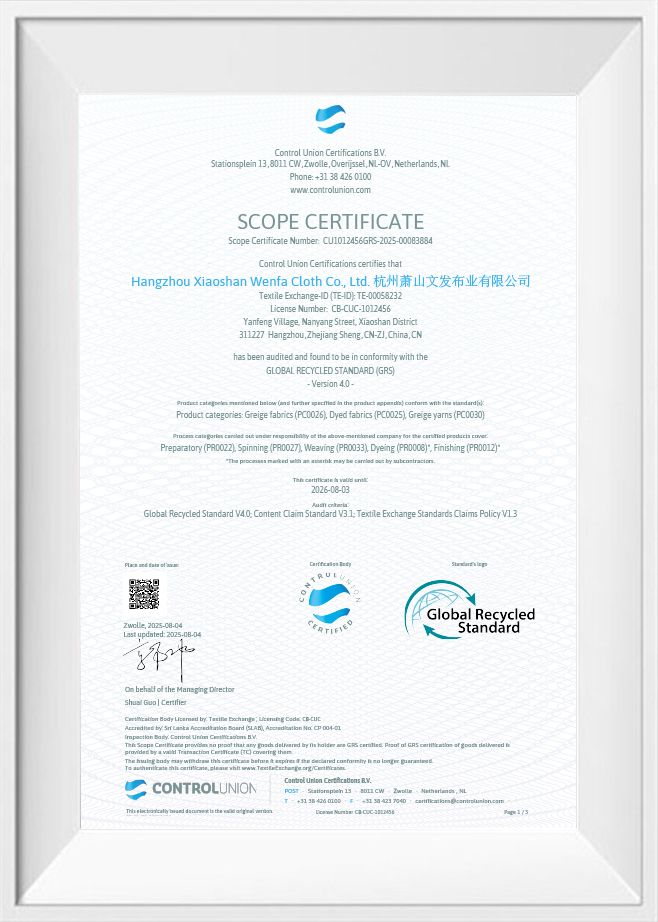
Modern procurement decisions balance functional performance with environmental accountability. For Anti-Uv Polyester Fabric, certifications such as REACH, GRS, and OBP offer a transparent framework to verify chemical safety, recycled content, and ocean-bound plastic prevention. REACH (SVHC compliance) guarantees that the UV additives and dyes do not introduce harmful substances. The Global Recycled Standard (GRS) provides chain-of-custody tracking for recycled polyester, while the Ocean Bound Plastic (OBP) certification confirms that raw material collection prevents plastic waste from entering marine ecosystems.
What each certification means for your supply chain
- REACH – Confirms no restricted chemicals, safeguarding market access in the EU.
- GRS – Validates recycled content percentage and ethical manufacturing, crucial for brand ESG goals.
- OBP – Demonstrates active contribution to reducing ocean plastic, adding a compelling story for end-consumers.
Hangzhou Xiaoshan Wenfa Textile Co., Ltd. integrates these certifications into our daily operations, ensuring every meter of Anti-Uv Fabric we supply can support your compliance documentation. This commitment to verified sustainability, paired with a daily output of approximately 160,000 meters, allows brands to scale responsibly without compromising on UV protection or material longevity.

 English
 русский
 Français
 Español
 中文简体
中文简体