How Coating-Fabric Bonding Affects Tear Resistance in Film Coating Fabric
The tear resistance of Film Coating Fabric depends not only on the strength of the base textile but heavily on the interfacial adhesion between the film layer and the substrate. A high-strength sealed layer performs optimally only when the bond line resists peel forces during dynamic stress. If the coating delaminates, the fabric loses structural integrity long before the fibers themselves fail.
Common bonding methods produce distinct adhesion profiles, directly influencing the minimum peel strength required for professional extreme-environment gear. We at Hangzhou Xiaoshan Wenfa Textile Co., Ltd. continuously monitor peel values to ensure each batch of Film Coating Fabric remains reliable under pack abrasion and multi-axial strain.
Bonding method and recommended minimum peel strength for durable Film Coating Fabric.
| Bonding Technology |
Process Characteristic |
Peel Strength (N/cm) |
| Hot-melt lamination |
Uniform film melt, controlled penetration |
≥ 6.0 |
| Solvent-based coating |
Deep fiber encapsulation |
≥ 5.5 |
| Aqueous dispersion |
Low-VOC, moderate film tenacity |
≥ 4.5 |
For expedition gear subjected to rough terrain, selecting a Film Coating Fabric with peel strength above 6 N/cm significantly reduces the risk of coating separation at stress points, making it a safer choice for critical seam areas and high-flex zones.
Beyond Static Waterproof Ratings: Evaluating Film Coating Fabric Durability
A high static hydrostatic head value on a datasheet does not guarantee waterproof reliability in the field. Film Coating Fabric is often rated at over 10,000 mmH₂O under calm conditions, yet repeated flexing, vibration, and temperature swings can introduce micro-cracks in the sealed layer that compromise performance.
Dynamic waterproof tests, such as the ISO 1420 rotary flex method or the modified ASTM D2099 Schildknecht flex test, reveal how well the coating endures real-world fatigue. As a result, procurement specifications for heavy-duty rainwear and bivy bags increasingly require these dynamic benchmarks.
- Static hydrostatic pressure (ISO 811) gives the baseline impermeability, typically >10,000 mm for Film Coating Fabric.
- Wet flex resistance (ISO 1420) subjects the material to repeated creasing under water, simulating pack-and-unpack fatigue.
- Abrasion-before-leak tests highlight whether the sealed layer remains intact after surface wear.
Our internal quality benchmarks for Film Coating Fabric focus on retaining over 80% of the initial hydrostatic resistance after 10,000 flex cycles. This threshold helps outdoor brands avoid field failures in extreme rain and wind, ensuring the complete water resistance promised by the membrane structure.
Why Film Coating Polyester Fabric Maintains Dimensional Stability in Harsh Conditions
The base fiber choice dramatically influences how a Film Coating Polyester Fabric behaves when exposed to moisture, UV radiation, and temperature fluctuations. Polyester absorbs significantly less water than nylon, with a moisture regain of just 0.4% compared to nylon’s 4.5%. This low hygroscopic expansion preserves the flat geometry of the fabric, keeping the film coating uniformly bonded without wrinkling or micro-delamination.
Key property comparison between polyester and nylon base fabrics for film coating applications.
| Property |
Polyester |
Nylon |
| Moisture regain (%) |
0.4 |
4.5 |
| UV strength retention after 500h (%) |
>90 |
<70 |
| Thermal shrinkage at 150°C (%) |
<1.5 |
>3.0 |
Film Coating Polyester Fabric therefore delivers a reliable platform for the sealed layer, especially in alpine and tropical expeditions where gear is repeatedly soaked and dried. As Film Coating Polyester Fabric Manufacturers, we select high-tenacity polyester yarns to further reduce elongation under load, helping the coating retain a continuous, crack-free barrier during intense use.
Navigating OEM/ODM Customization for Certified Film Coating Polyester Fabric
Ordering custom Film Coating Polyester Fabric involves decisions that reach far beyond color and width. The film type, coating weight, bonding method, and base fabric denier all interact to determine final tear strength, hand feel, and waterproof life. A structured OEM/ODM process helps professional gear brands minimize trial runs and achieve consistent batch-to-batch quality.
- Define the exact use case and test standards (tent floor, dry bag, protective cover).
- Select base fabric specifications—denier, weave, and yarn type—to match the required tear resistance.
- Choose film chemistry and coating weight; TPU and PU films dominate for their balance of flexibility and complete water resistance.
- Validate bonding method and peel strength through lab-scale trials before pilot production.
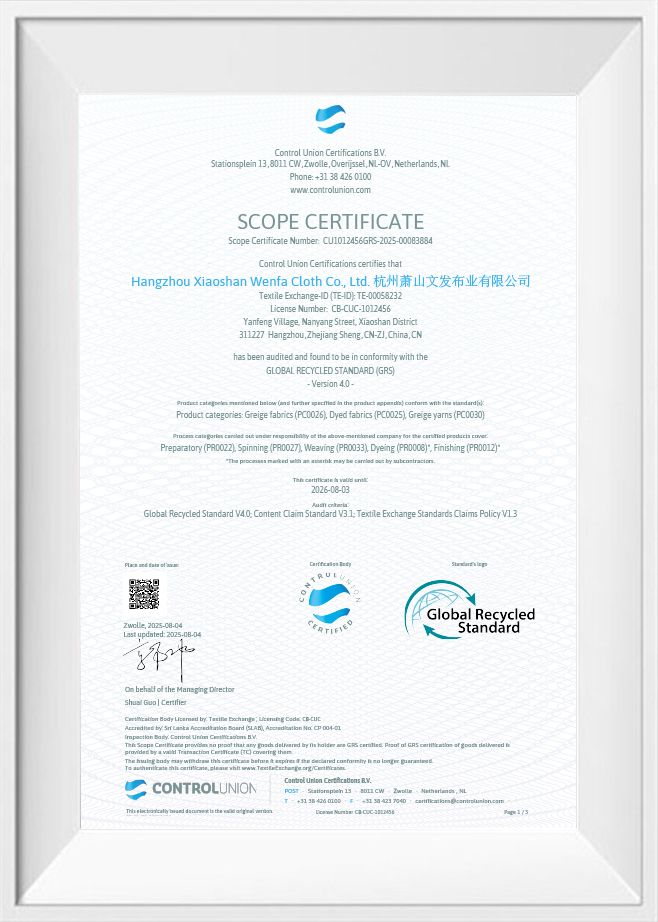
- Confirm certification compliance (REACH, GRS, OBP) to meet regulatory demands in Europe and the Americas.
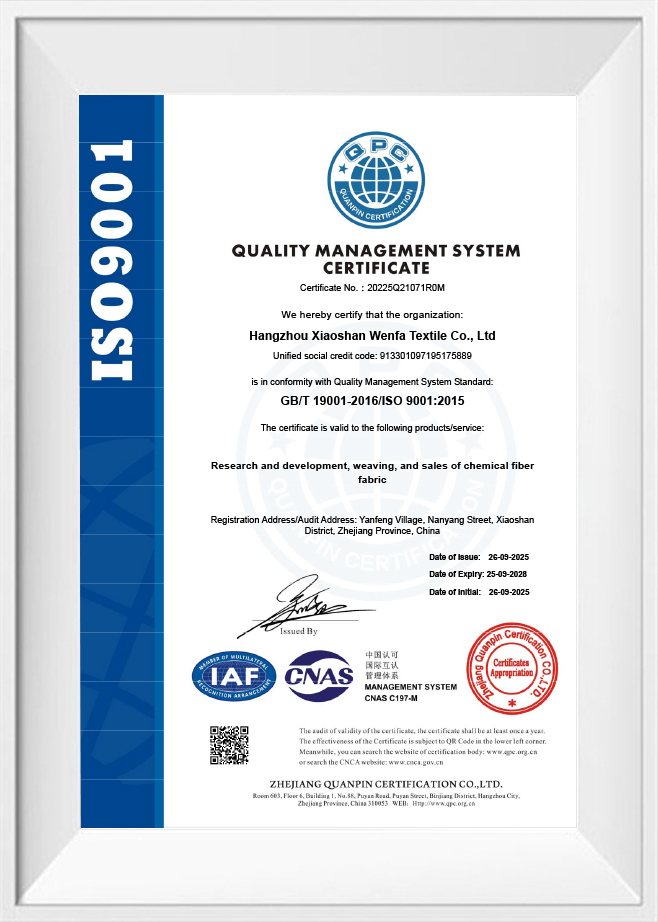
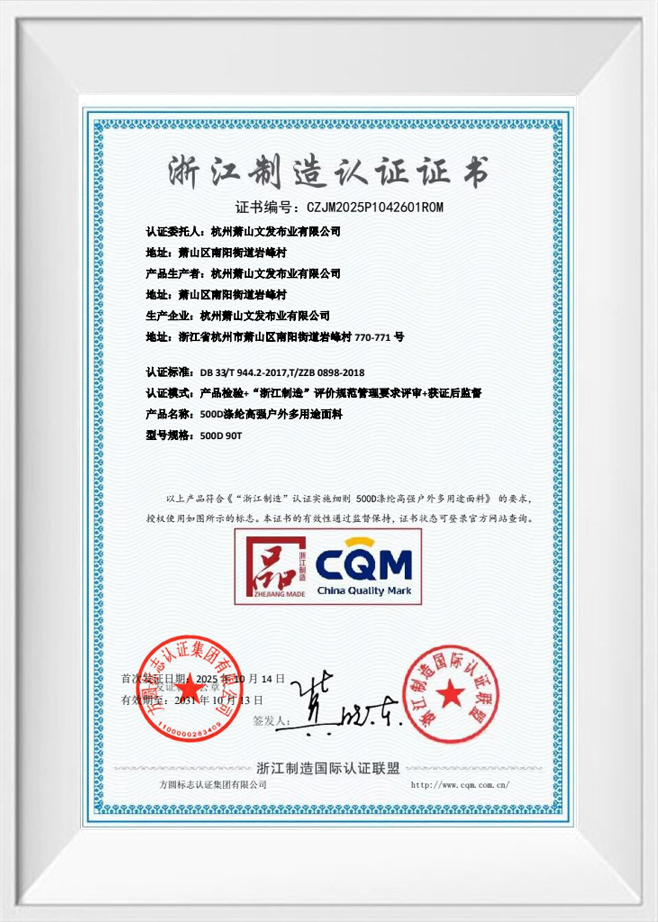
Hangzhou Xiaoshan Wenfa Textile Co., Ltd. operates an integrated OEM/ODM Film Coating Fabric Factory with nearly 300 water-jet looms and a daily output of 160,000 meters. This capacity supports both rapid sampling and full-scale runs for custom Film Coating Polyester Fabric. Our REACH, GRS, and OBP certifications give buyers documented assurance that every roll meets stringent chemical and sustainability requirements, essential for children’s products and outdoor gear shipped worldwide.

 English
 русский
 Français
 Español
 中文简体
中文简体