Matching Denier to Your Load: 300D, 600D, and 900D in Practical Applications
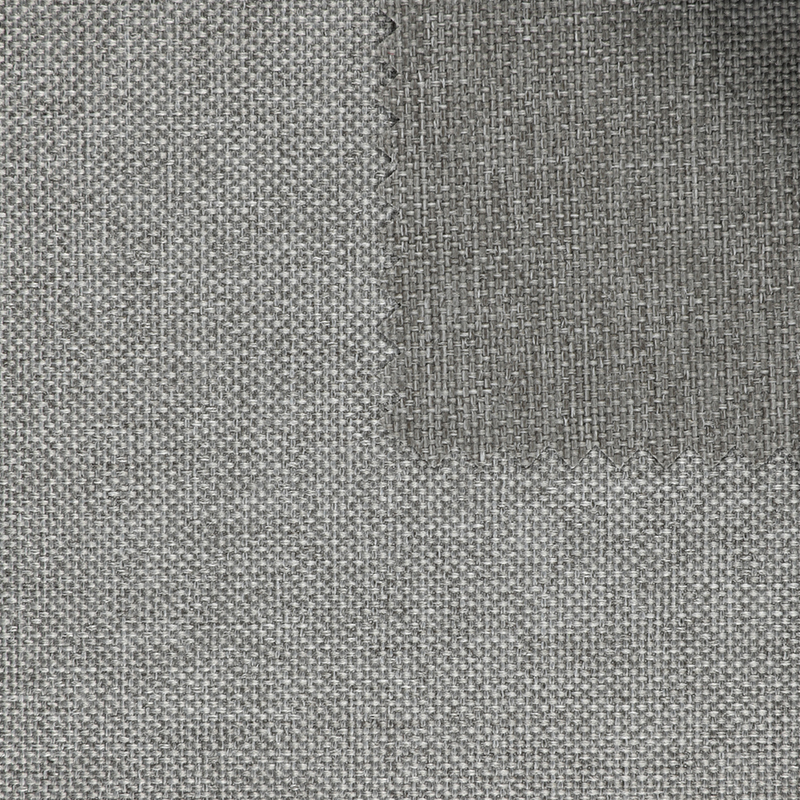
The denier number—expressed as a unit of linear mass density—tells only part of the story. While a higher D often suggests a heavier, more robust fabric, the actual tear strength and stiffness depend equally on weave density and finishing processes. Understanding these nuances helps you avoid over-engineering a lightweight daypack or under-specifying a heavy-duty tool bag.
Typical performance comparison across common outdoor polyester deniers (approximate values)
| Property |
300D Waterproof Outdoor Fabric |
600D Waterproof Outdoor Fabric |
900D Waterproof Outdoor Fabric |
| Weight (gsm, approx.) |
190 – 230 |
270 – 320 |
370 – 430 |
| Tear strength (N, warp/weft) |
25 – 40 |
50 – 80 |
90 – 140 |
| Hand feel & drape |
Soft, flexible |
Balanced semi-rigid |
Stiffer, structured |
| Preferred end uses |
Packable rain covers, light daypacks, stuff sacks |
Backpacks, duffel bags, equipment cases |
Heavy-duty tool bags, protective covers, ATV luggage |
When selecting between a 300D waterproof outdoor fabric and a 600D waterproof outdoor fabric for a roll-top backpack, the decision often hinges on the load-bearing seams. A 600D body paired with a 900D waterproof outdoor fabric base reinforcement frequently yields the best durability-to-weight ratio. At Hangzhou Xiaoshan Wenfa Textile Co., Ltd., we help customers match denier to real mechanical demands rather than just price per yard.
The Invisible Shield: How Coating Chemistry Drives Performance
Polyester fibers alone are not waterproof—their protective power comes from a rear-side coating or laminate. The most common backings are polyurethane (PU) and polyvinyl chloride (PVC), each with distinct trade-offs. PU coatings offer superior flexibility and lighter weight, while PVC excels in heavy-industrial settings where weldability and chemical resistance matter more than suppleness.
A critical metric is the hydrostatic head rating. A general-purpose Outdoor Polyester Waterproof Fabric may withstand 800–1,500 mm of water column, sufficient for light rain. Premium outdoor gear often demands ratings of 3,000–5,000 mm or higher, especially when fabric is stretched over frame stays or subjected to sustained pressure from pooled water. Equally important is the adhesion of the coating—measured by a peel test—because a coating that delaminates after 50 wet-dry cycles rapidly turns a waterproof shell into a leaky membrane.
- PU multiple coats: excellent flex crack resistance, ideal for foldable backpacks
- PVC coating: high abrasion resistance, commonly used for truck tarpaulins
- TPU film lamination: combines elasticity and very high waterproofness, but at a cost premium
Our production lines at Hangzhou Xiaoshan Wenfa Textile Co., Ltd. apply precise coating weights to transform standard greige polyester into high-performance Outdoor Polyester Waterproof Fabric, achieving consistent hydrostatic head values across every production lot.
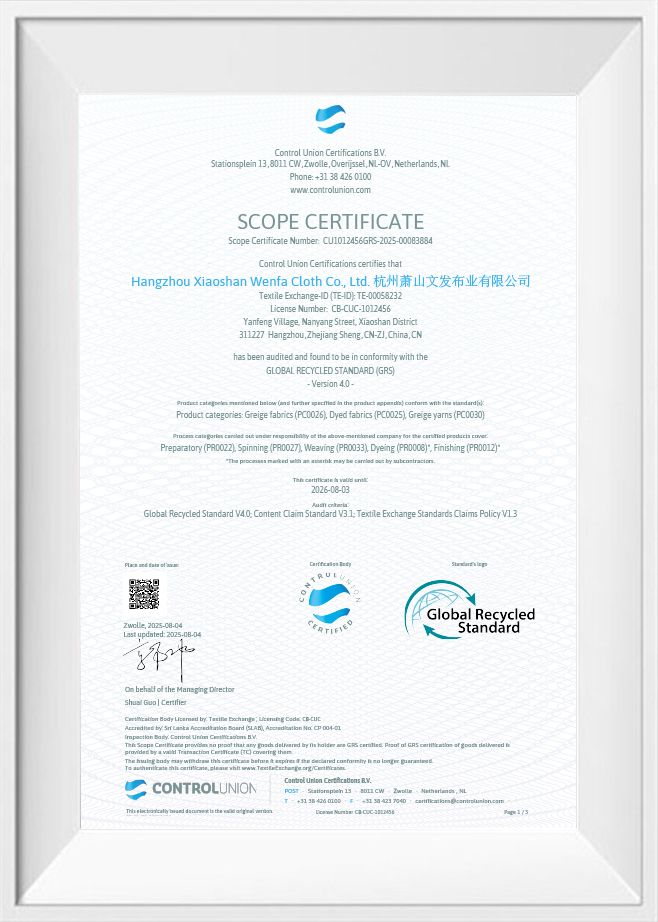
Certifications That Matter: REACH, GRS, and OBP Beyond the Labels
For brands selling into Europe or partnering with ESG-conscious retailers, a mill’s certifications directly impact market access. REACH compliance confirms that the fabric contains no restricted substances of very high concern—a non-negotiable baseline. The Global Recycled Standard (GRS) goes further, verifying recycled content throughout the supply chain and setting social and environmental requirements for production sites. Ocean Bound Plastic (OBP) certification assures that the polyester yarn originates from plastic waste collected within 50 km of coastlines, addressing a critical circular-economy goal.
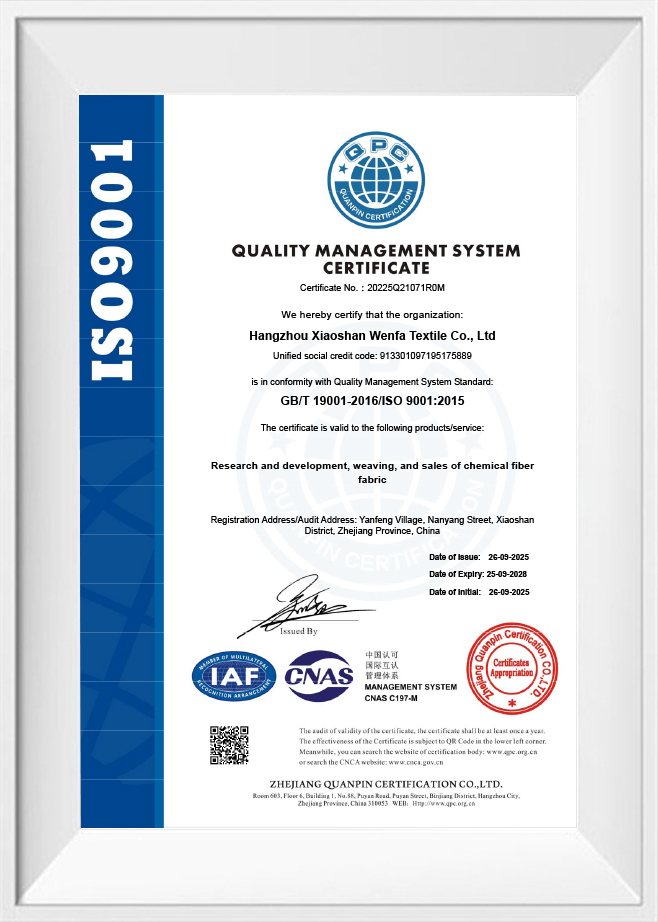
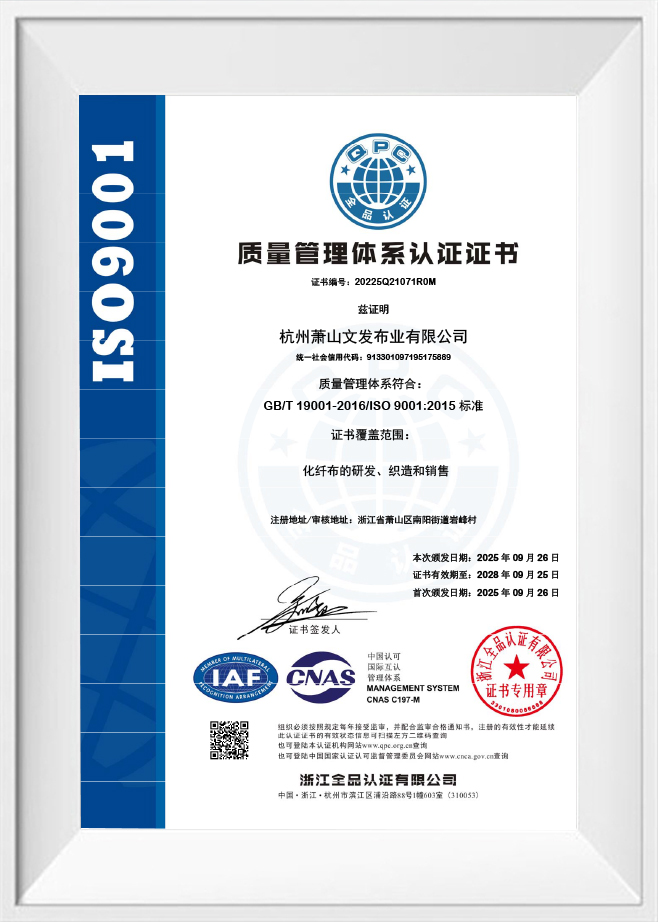
Why does this matter when choosing a waterproof outdoor fabric? Because many conventional waterproof coatings and dyeing processes historically used chemicals now restricted or undesirable. A GRS-certified 600D waterproof outdoor fabric with a compliant PU backing, for instance, lets you market your product with verified sustainability claims rather than vague “eco-friendly” phrasing. At Hangzhou Xiaoshan Wenfa Textile Co., Ltd., our ISO, REACH, GRS, and OBP credentials are integrated into our daily quality management, so you can trace your 300D waterproof outdoor fabric or 900D waterproof outdoor fabric back to audited processes.
Extending Product Life: Cleaning, Storage, and DWR Revival
The right way to clean coated polyester
Abrasion and hydrolysis are the two silent killers of Outdoor Polyester Waterproof Fabric. Dirt particles act like sandpaper against the coating; trapped moisture accelerates hydrolytic degradation of the PU layer. Clean your gear with lukewarm water and a pH-neutral soap, never with bleach or fabric softeners. Avoid machine drying above 40°C—excess heat can cause the coating to blister or peel.
When and how to restore water repellency
The face fabric often receives a durable water repellent (DWR) finish that causes water to bead up. This finish degrades with friction and soil. You can reactivate some DWR treatments by tumbling the item in a dryer on low heat, or apply a spray-on renewal product specifically designed for coated polyester. Testing shows that a regular DWR refresh can prolong the effective waterproof life by 40–60% in high-use scenarios.
Storage that prevents micro-cracks
- Store completely dry in a well-ventilated area away from UV exposure
- Do not compress folded seams for long periods; rolling is gentler on the coating
- Avoid direct contact with PVC-based items, as plasticizer migration can damage PU coatings
All our outdoor fabrics—from 300D waterproof outdoor fabric to 900D waterproof outdoor fabric—are engineered to maintain coating integrity through repeated cleaning cycles, but attentive care always translates into longer field service.

 English
 русский
 Français
 Español
 中文简体
中文简体