OBP Claim Integrity: What Bulk Buyers Should Request Beyond a Certificate
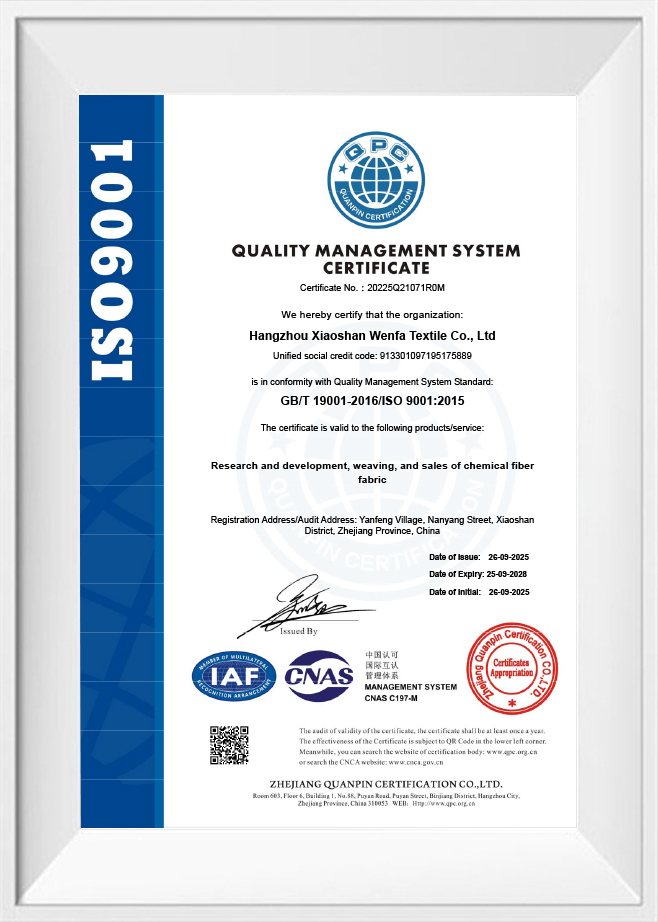
In OBP procurement, the biggest operational risk is “certificate-only buying.” For bulk orders, you should validate the full chain: OBP Certificate Fabric collection geography, recycler qualification, conversion steps, and transaction traceability. A practical approach is to require document sets per production lot rather than per season.
- Ask for lot-level transaction certificates covering the polymer input and output, plus supporting invoices/weight tickets where applicable.
- Confirm whether the claim is mass-balance or physical segregation. Do not assume “OBP” automatically means 100% physically segregated content.
- Request a process flow summary (collection → sorting → washing → pelletizing → spinning → weaving) showing where certification controls are applied.
- Set acceptance criteria in your PO for claim language (e.g., “OBP recycled content” vs. “recycled polyester”), so labeling and compliance teams align before production.
From our side, we keep output stable for bulk supply with industrial capacity and documented controls—so you can focus on sell-through, not claim disputes.
How to Write OBP Certificate Fabric Specs That Reduce Rework and Lab Failures
Bulk buyers often lose time because specs focus on “recycled content” but omit fabric-engineering details that control outcome. For Oxford fabric, align specs on structural variables, finishing, and performance tests so sampling results scale to production.
Spec elements that most often cause mismatch
- Weave and yarn parameters (e.g., yarn denier, filament vs. spun, weave density) tied to handfeel and tear strength.
- Dyeing method and shade tolerance (ΔE) plus colorfastness targets by end-use.
- Coating/lamination type and add-on level: water resistance and abrasion are sensitive to finish formulation.
- Dimensional stability requirements after washing/heat exposure for garment vs. home textile applications.
A good PO reads like an engineering brief: it defines structure, finish, and test method. When your spec is precise, our production system can reproduce it consistently at scale.
Water Resistance on Oxford: What “Waterproof” Actually Means in Purchase Terms
For Oxford fabrics, “waterproof” is commonly used loosely. In procurement, you should translate it into measurable requirements: hydrostatic head, spray rating, seam behavior (if used in finished goods), and durability after abrasion and laundering.
Suggested way to specify water performance
- Define a hydrostatic head target and the test method your lab will use; confirm whether it applies to greige, finished fabric, or after aging.
- State whether performance must hold after abrasion cycles and wash cycles; initial lab results are not the same as durability.
- Clarify if a DWR (water-repellent) surface is acceptable vs. a coated/laminated waterproof barrier.
OBP content does not prevent high water performance; finish engineering does. We routinely align the finish package to your end-use, so the claim and the function move together.
Abrasion, Tear, and Pilling: Choosing the Right Durability Trio for Your End-Use
Durability is not one metric. Bulk buyers should choose a durability “trio” that matches the product: abrasion for surface wear, tear for structural integrity, and pilling for appearance retention. Setting the wrong trio leads to overspending or unexpected failures.
How to map durability tests to common Oxford fabric applications
| Application |
Primary risk |
Most relevant durability focus |
| Backpacks & bags |
Surface wear + seam stress |
Abrasion + tear |
| Outdoor jackets |
Appearance + comfort retention |
Pilling + abrasion |
| Workwear |
Rips under load |
Tear + seam slippage |
| Home textiles (covers) |
Abrasion + pilling visibility |
Abrasion + pilling |
A common mistake is to demand maximum scores across all tests. The better approach is: optimize the trio for the end-use, then engineer the fabric structure and finish accordingly.
Color Consistency at Scale: Managing Shade Drift in Bulk OBP Orders
Shade drift is a commercial risk in bulk textile supply: it triggers garment QC issues, returns, and re-dye costs. With recycled inputs, disciplined process control becomes even more important. Buyers can reduce drift by standardizing approvals and defining “what good looks like.”
Controls that materially reduce shade disputes
- Approve a lab dip and a bulk standard (sealed swatch) and reference it in every PO and re-order.
- Define lighting conditions for evaluation and the instrument tolerance your QC uses.
- Require a continuity plan: what happens if a re-order occurs months later (dye recipe lock, standard retention, and batch matching strategy).
Wenfa operate with stable manufacturing capacity so your repeat orders can stay consistent. When you win at consistency, the “sustainable story” is easier to scale commercially.
Restricted Substances and Market Access: How REACH Impacts Fabric Purchasing Decisions
For Europe-facing supply chains, compliance is not a checkbox; it is a market access requirement. REACH alignment typically shows up in dye chemistry selection, finishing auxiliaries, and controlled substances screening. Bulk buyers should translate this into supplier documentation and change-control discipline.
Procurement practices that reduce compliance exposure
- Lock a chemical management baseline: once a finish package passes your RSL/MRSL checks, require notification before any substitution.
- Specify whether testing is required per colorway, per finish, or per production lot; your testing scope determines your true compliance cost.
- Request up-to-date test reports for high-risk parameters relevant to your product category and retailer requirements.
Because Wenfa already work across Europe and other international markets with established compliance routines, we can integrate your brand’s RSL needs into the production workflow with minimal friction.
GRS and OBP Together: How to Avoid Confusing Claims in Product Copy
Brands often hold multiple sustainability standards at once (e.g., GRS plus OBP). The operational challenge is not the fabric—it is the claim language. Mixing standards incorrectly can trigger compliance issues, retailer rejections, or greenwashing risk. A clean approach is to map each claim to its supporting evidence.
Simple claim mapping: what each standard supports in commercial communication
| Your intended message |
Typical supporting evidence |
Common pitfall to avoid |
| Recycled content in the fabric |
Transaction certificates / scope certificates |
Using “certified” without specifying what is certified |
| Ocean-bound plastic origin story |
OBP chain-of-custody documentation |
Implying the product was collected from the ocean |
| Responsible production controls |
ISO systems, audit outcomes, QC records |
Overclaiming social/environmental impact without measurement |
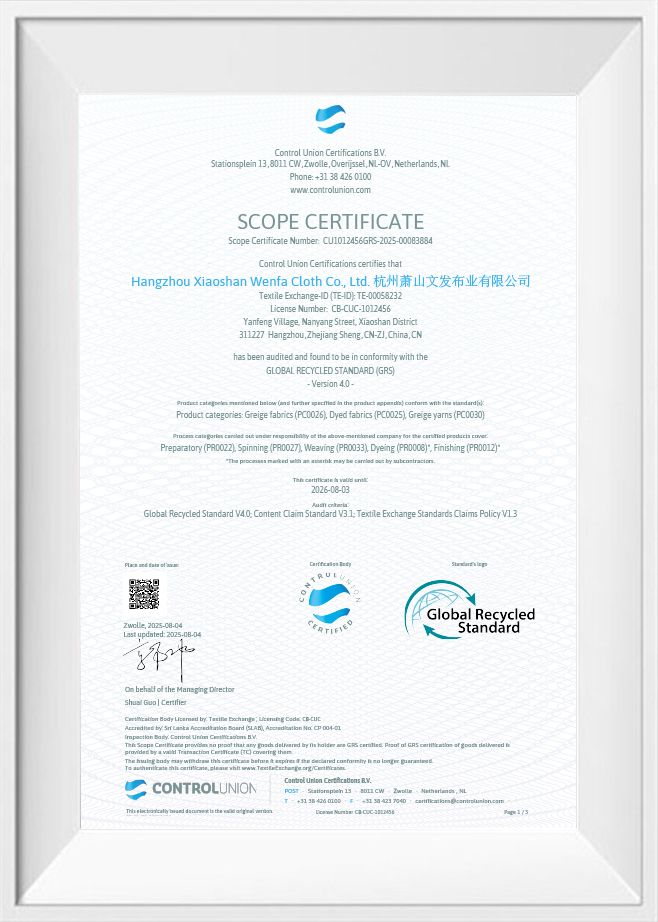
When claims are clean, conversion is easier. Wenfa keep documentation organized so your compliance team can approve copy faster and your sales team can sell with confidence.
Order Planning for Large Volumes: Lead-Time Levers Buyers Can Actually Control
In bulk textile orders, lead time is rarely “fixed.” It is the sum of controllable levers: color approvals, material allocation, finishing scheduling, lab testing windows, and packing specifications. Buyers who manage these levers proactively reduce expediting costs and split-shipments.
Tactics that shorten lead time without sacrificing quality
- Freeze colorways earlier and limit last-minute shade changes; every color revision cascades through dyeing and testing.
- Standardize packing and labeling requirements across SKUs; packaging complexity can become a hidden bottleneck.
- Align inspection approach (AQL level, lab test list, and sampling plan) before production starts, not after fabric is finished.
With industrial-scale weaving capacity and stable output, Wenfa are set up for consistent bulk supply—your planning discipline is what converts that capacity into faster delivery and fewer surprises.

 English
 русский
 Français
 Español
 中文简体
中文简体